ESA Tracks Rare Comet from Another Star System — Only the Third Ever Found
The European Space Agency (ESA) says it has spotted a “visitor from beyond the void” — a rare comet that came from outside our solar system.
In a bulletin on July 3, the ESA confirmed the discovery of this interstellar comet, now officially named 3I/ATLAS. It’s only the third object of its kind ever seen, following 1I/ʻOumuamua in 2017 and 2I/Borisov in 2019.
This means the comet didn’t form in our solar system but came from a distant star system elsewhere in the galaxy.
The comet was first seen on July 1 by a telescope in Río Hurtado, Chile, part of a system called ATLAS, which watches for objects that might hit Earth. Its strange path through space made astronomers think it came from beyond our solar system. Later, scientists around the world confirmed it was an interstellar object.
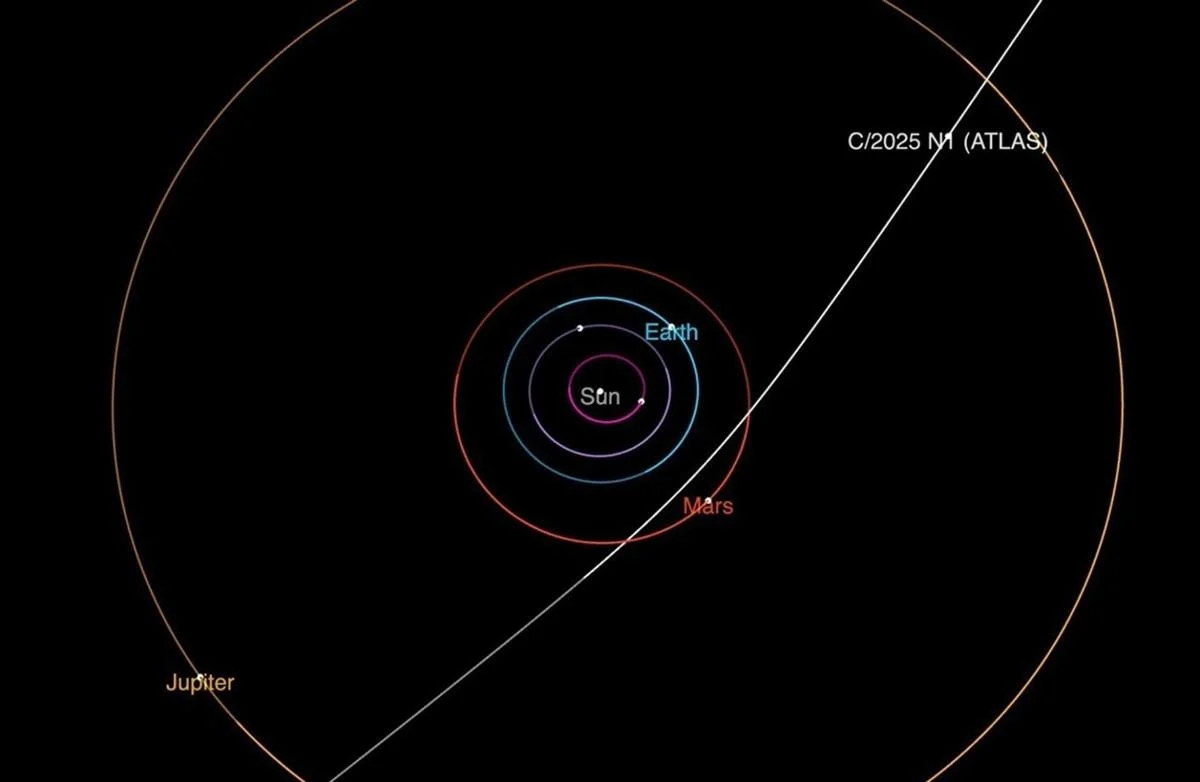
3I/ATLAS is currently about 670 million kilometres from the sun. In comparison, Earth is around 149 million kilometres away. The comet will get closest to the sun in October 2025, when it will pass just inside the orbit of Mars.
The ESA says the comet might be up to 20 kilometres wide and is moving at about 60 kilometres per second relative to the sun. Thankfully, it poses no threat to Earth — it will stay at least 240 million kilometres away, which is more than 1.5 times the distance between Earth and the sun.
ESA’s Planetary Defence Office quickly began tracking the comet. Their alert system notified astronomers to follow its path and check past data to see if the comet had been spotted earlier — a process called “precovery.”
Scientists are excited to study 3I/ATLAS because interstellar comets are extremely rare. They hope to learn more about its makeup and how it behaves. Unfortunately, when the comet is closest to Earth, it will be behind the sun and hard to see. NASA says it will likely stay visible through September 2025 and reappear by early December.
What makes this discovery special is that the comet likely formed in a completely different planetary system. Everything in our solar system — planets, moons, asteroids, and comets — formed from the same material. But interstellar objects like 3I/ATLAS come from entirely different systems, offering clues about how other worlds form.
The ESA says that while it could be thousands of years before humans visit planets outside our solar system, interstellar comets give us a way to study those places from afar. In the future, the ESA plans to launch a mission to wait in space for a comet — possibly another “visitor from beyond the void.”